That stain isn't always where the leak is. We trace it to its true source — before you fix the wrong thing.
A brown ring on the ceiling. Paint bubbling on a bedroom wall. A musty patch behind the washing machine. Water stains are maddening because water travels — it runs along framing, pipes, and the back of drywall, then drips or seeps far from where it entered. Fixing the stain's location without finding the source is how homeowners end up repairing the same spot twice.
Wall and ceiling leak detection is differential diagnosis: plumbing leak, roof issue, condensation, or appliance fault — each needs a different fix. We identify the true source with thermal imaging and moisture meters, so the right repair happens once.
Water obeys gravity and follows the easiest path, not the shortest one. A leak from an upstairs shower pan can travel along a joist for six feet before dripping through the ceiling below — directly over the dining table, nowhere near the bathroom. Condensation on a cold pipe can mimic a pipe leak. A roof flashing failure can present as a wall stain two rooms away from the actual entry point.
The costliest mistake is treating the stain's location as the problem's location — cutting open the wall, finding nothing, and watching the stain return. Detection exists to break that cycle.
Every wall or ceiling stain falls into one of a few categories, and the evidence distinguishes them. Plumbing leaks — supply or drain — typically show regardless of weather and often sit below bathrooms, kitchens, or laundry areas; supply leaks run constantly, drain leaks appear when fixtures are used. Roof issues show during or after rain and favor top-floor ceilings near flashing, valleys, or penetrations. Condensation appears in humid conditions on cold surfaces — uninsulated ducts, cold-water pipes, poorly ventilated bathrooms. Appliance faults — A/C condensate drains, water heaters, washing machines — leave their own telltale patterns.
Our role is the plumbing side of that differential, pursued honestly. If the evidence points to the roof, we will tell you to call a roofer — roof leak work belongs to roofing contractors, and we do not pretend otherwise.
Before we arrive, the single most useful thing you can observe is timing. Does the stain darken or grow only during rain? That points upward, toward the roof or flashing. Does it appear when the upstairs shower runs but stay quiet otherwise? That points to a drain or shower pan. Is it constant, growing slowly week by week regardless of weather or fixture use? That points to a pressurized supply leak — the kind that does the most damage over time.
Note the pattern and photograph the stain with dates. When our technician arrives with thermal imaging and moisture meters, your observations combine with the instrument readings to close the case faster.
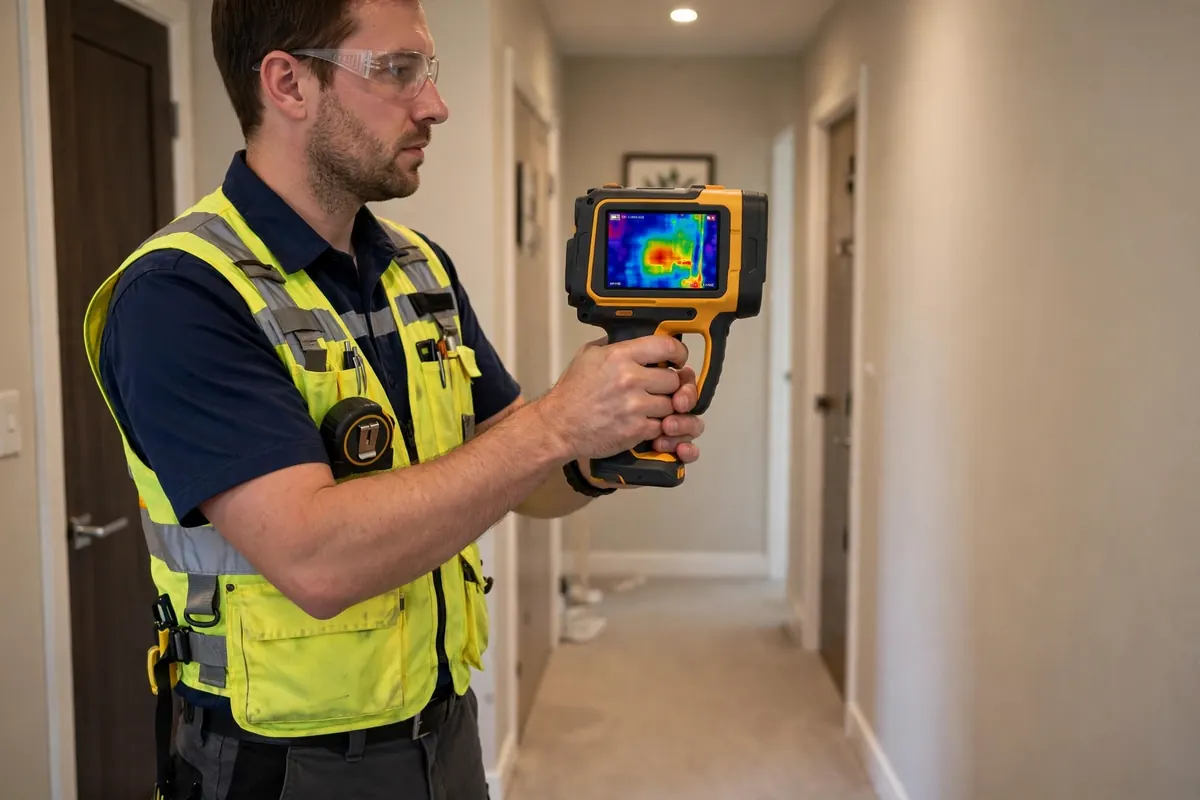
The investigation starts with a thermal imaging scan of the stained area and its surroundings — moisture changes surface temperature, so the camera reveals how far the dampness actually extends, which is usually farther than the visible stain. Pin and pinless moisture meters then confirm which areas are actively wet versus merely discolored from an old, resolved leak — an important distinction, because a stain can remain long after its cause is gone.
From there we trace backward: acoustic listening if a pressurized pipe is suspect, controlled fixture tests (running the shower above while watching the meters) for drain-side suspects, and fixture-by-fixture elimination. You get a source identified, not a guess.
Most stains can wait for a scheduled visit. Two situations cannot: water near electrics — light fittings, outlets, or switches in or below the stained area — and sagging drywall or plaster, which can collapse without warning. If water is near a light fitting, switch off that lighting circuit at the breaker and keep the area clear.
A stain that is actively growing day by day also deserves prompt attention, since it signals an ongoing pressurized leak rather than a one-time event. When in doubt, a quick call costs nothing and we will tell you honestly whether it can wait.
We review your observations — timing, weather correlation, fixture use — and photograph the current state.
Infrared imaging maps the full extent of moisture, which typically extends beyond the visible stain.
Pin and pinless meters distinguish active wetness from old, resolved staining.
We trace the moisture path backward — acoustic checks, controlled fixture tests, elimination — to the entry point.
You learn the source category (plumbing, roof, condensation, appliance) and the correct next step — including a roofer referral when appropriate.
Infrared cameras that reveal the heat signature of hidden water — without a single hole in your walls.
Learn more →Electronic listening that pinpoints hidden leaks — without tearing open walls or digging up floors.
Learn more →Finding the leak is step one. Mapping exactly how far the water traveled is step two.
Learn more →A live look inside your pipes — see the blockage, break, or root intrusion with your own eyes.
Learn more →Every day a hidden leak runs, the water bill climbs and the damage spreads. Call now — we answer 24 hours a day.
+1 626-898-6221 ☎ Call Now Request Leak Detection Service