Prove the leak exists — and isolate exactly which line it is on — before any pinpointing begins.
Before spending time hunting a leak's precise location, it pays to answer two simpler questions: is water actually escaping, and which pipe is it escaping from? Pipeline pressure testing answers both. Sections of pipe are isolated with valves, pressurized in a controlled way, and monitored with gauges — a pressure drop with no fixtures in use means water is leaving that section somewhere.
Think of it as the diagnostic foundation every other method builds on. Acoustic listening, thermal imaging, and tracer gas all pinpoint leaks brilliantly — but they work fastest and most accurately when a pressure test has already narrowed the search to the right line. In Alhambra's older homes with sprawling, modified-over-decades plumbing, that narrowing step saves real time.
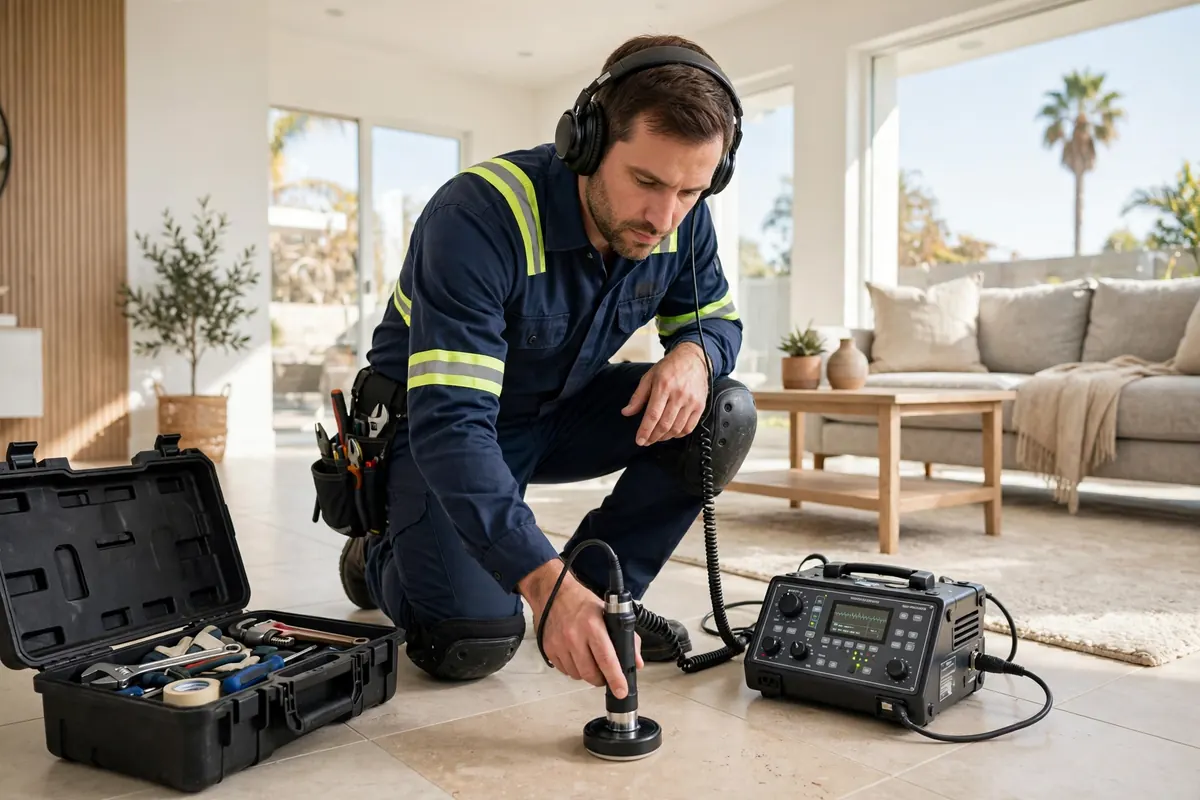
The principle is straightforward: a sealed section of pipe should hold its pressure. The technician closes isolation valves to segment the system — hot versus cold, upstairs versus downstairs, interior versus the service line — then pressurizes each section to a test pressure appropriate for its material and watches a gauge or data logger. A steady reading means the section is sound; a falling reading means water is escaping.
For drain and sewer lines, a hydrostatic variant is used: the line is plugged and filled with water, and a dropping water level reveals the breach. Either way, the outcome is the same — confirmation plus isolation, delivered as documented readings rather than opinion.
An important expectation to set: pressure testing confirms a leak exists and narrows it to a section of pipe, but it does not mark the exact spot. Knowing the leak is on the hot-water run under the hallway, rather than somewhere in the entire house, is enormously valuable — it just isn't the final answer.
The pinpoint comes next, and the pressure test tells the technician which tool to reach for: acoustic listening for the pressurized slab line, thermal imaging for the hot-water run behind a wall, tracer gas for the elusive pinhole. Each method performs better when it starts from a confirmed, isolated section instead of a whole-house mystery.
Professional leak investigations follow a disciplined order, and pressure testing sits at its center: meter check first (is water actually being lost?), then pressure testing (which section?), then pinpointing (exactly where?), then marking and reporting. Skipping the middle step is how investigations go wrong — technicians chase sounds or heat signatures on the wrong line while the real leak sits undisturbed elsewhere.
For slab-leak work specifically, the hot-versus-cold isolation is the highest-value test in the sequence. A hot-side loss points to the water heater loop; a cold-side loss points elsewhere entirely — and the repair plan differs completely between the two.
Worth clarifying because the terms sound similar: backflow testing is a separate, regulated compliance service for backflow prevention devices, with its own testers and schedules — the City of Alhambra even publishes a backflow tester referral list. It has nothing to do with finding leaks.
Likewise, this page covers residential and commercial plumbing pressure testing only — not gas-line pressure testing, which is a separate safety-regulated matter. If what you need is leak confirmation on your water lines, you are in the right place.
We confirm water is actually being lost and note the system's layout, materials, and valve locations.
Isolation valves divide the plumbing into testable sections — hot vs. cold, interior vs. service line.
Each section is pressurized to a material-appropriate test pressure and allowed to stabilize.
Gauges or data loggers track each section over time; a pressure drop with no usage proves a leak in that section.
The confirmed section is handed to the pinpoint method — acoustic, thermal, or tracer gas — with a documented starting point.
Electronic listening that pinpoints hidden leaks — without tearing open walls or digging up floors.
Learn more →Infrared cameras that reveal the heat signature of hidden water — without a single hole in your walls.
Learn more →A safe hydrogen tracer gas that escapes through the tiniest cracks — and leads our sensors straight to the leak.
Learn more →Find the leak under your concrete foundation — and open one precise spot instead of the whole floor.
Learn more →Every day a hidden leak runs, the water bill climbs and the damage spreads. Call now — we answer 24 hours a day.
+1 626-898-6221 ☎ Call Now Request Leak Detection Service