See the problem with a camera — then know exactly where it is underground, and how deep.
A camera inspection shows you what is wrong inside your sewer or drain line. Tracking and locating answers the other half of the question: where — the precise surface position and depth of every defect the camera found. Together, they turn an underground mystery into a mapped, measurable plan.
This matters most when a repair is on the table. Knowing a cracked section sits eight feet down under the driveway versus three feet down in the planting bed changes the repair method, the cost, and the disruption completely. In Alhambra, where clay and cast-iron laterals from the last century are now meeting mature tree roots, that knowledge is worth having before anyone brings equipment.
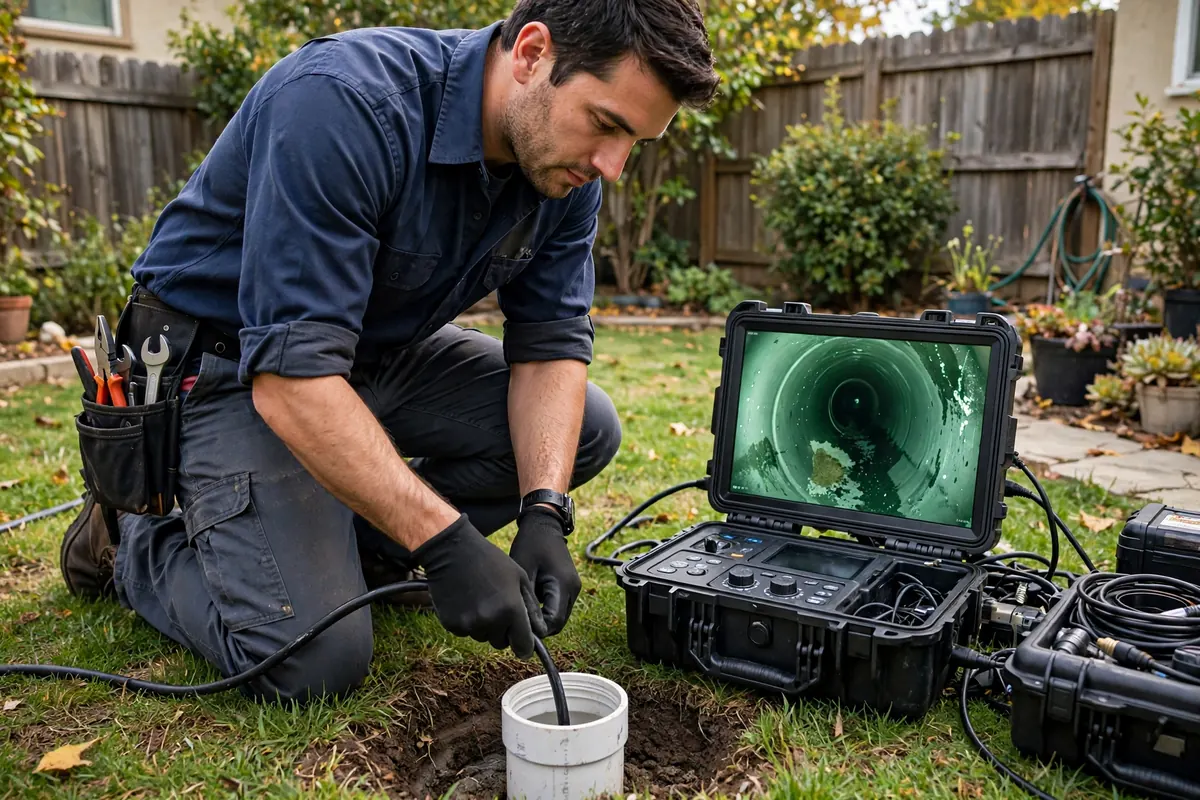
Think of the two services as a pair. The video camera travels the line and records every defect — root masses, cracks, offsets, bellies — with a footage counter showing how far into the pipe each one sits. But '47 feet from the cleanout' means little to a repair crew standing in your yard.
Tracking closes that gap. The camera head carries a transmitter; a locator wand above ground follows its signal and marks each defect's position on the surface with paint or flags, along with its depth. The result is a surface map of your underground line: every problem point visible from above, measurable, and ready for precise repair planning.
A defect three feet deep in soft soil is a straightforward spot repair. The same defect nine feet deep under a concrete driveway is a different project entirely — possibly a candidate for trenchless methods instead. Without tracking data, repair quotes are built on assumptions; with it, they are built on measurements.
Tracking also protects what is above ground. Landscaping, hardscaping, and new construction like ADUs all benefit from knowing exactly where the lateral runs and where its weak points are — so a new patio doesn't get poured over a cracked clay joint that will need attention next year.
Local plumbers consistently name tree-root intrusion as the top cause of sewer blockages in Alhambra, and the mechanism is simple: roots seek moisture, find the vapor escaping from tiny cracks or loose joints in old clay and cast-iron pipe, and grow in. What starts as fine tendrils becomes a dense mass that catches waste, causes backups, and eventually breaks the pipe.
Camera plus tracking is the definitive answer to root problems: the camera shows how far the intrusion has progressed and whether the pipe is still structurally sound, while tracking marks exactly where the invaded section lies — so treatment or repair targets the real location instead of the whole lateral.
A pre-purchase sewer scope that finds problems raises the next question: how bad, and where? Tracking answers it. A single shallow defect near the property line is a manageable negotiation point; multiple deep defects under the house are a different conversation. Either way, you negotiate from a map, not a vague 'the sewer has issues.'
For Alhambra's older-home market — where 80%+ of the housing stock is over 30 years old — combining the camera inspection with full tracking is the most complete pre-purchase sewer assessment available. The documentation also serves you after purchase, when any future plumber can see exactly what was found and where.
A video inspection records every defect with its distance along the pipe from the access point.
A locator follows the camera head's transmitter from above ground, marking each defect's surface position.
The locator reads each defect's depth, distinguishing shallow digs from deep or trenchless candidates.
Positions and depths are marked on the surface and transferred to a sketch or report you keep.
You receive the video, the map, and a plain-language summary any contractor can quote from accurately.
A live look inside your pipes — see the blockage, break, or root intrusion with your own eyes.
Learn more →A new pipe inside your old pipe — rehabilitate the line without trenching the property.
Learn more →One failed joint, one isolated crack — repaired from inside the pipe, without digging up the line.
Learn more →Unexplained water loss across your property? A systematic survey finds it — with minimal disruption to operations.
Learn more →Every day a hidden leak runs, the water bill climbs and the damage spreads. Call now — we answer 24 hours a day.
+1 626-898-6221 ☎ Call Now Request Leak Detection Service