Electronic listening that pinpoints hidden leaks — without tearing open walls or digging up floors.
Water escaping from a pressurized pipe makes a distinct sound — a hiss, whoosh, or vibration that travels along the pipe wall and through the surrounding soil or concrete. Acoustic leak detection uses highly sensitive ground microphones and contact sensors to hear that sound and trace it to its loudest point, which sits directly above the leak.
Across Alhambra — where more than 80% of homes are over 30 years old and many still run on aging galvanized, cast iron, or copper lines — acoustic listening is the first method our technicians reach for. It is completely non-invasive: sensors rest on the surface, so there is no drilling, cutting, or excavation just to find the problem.
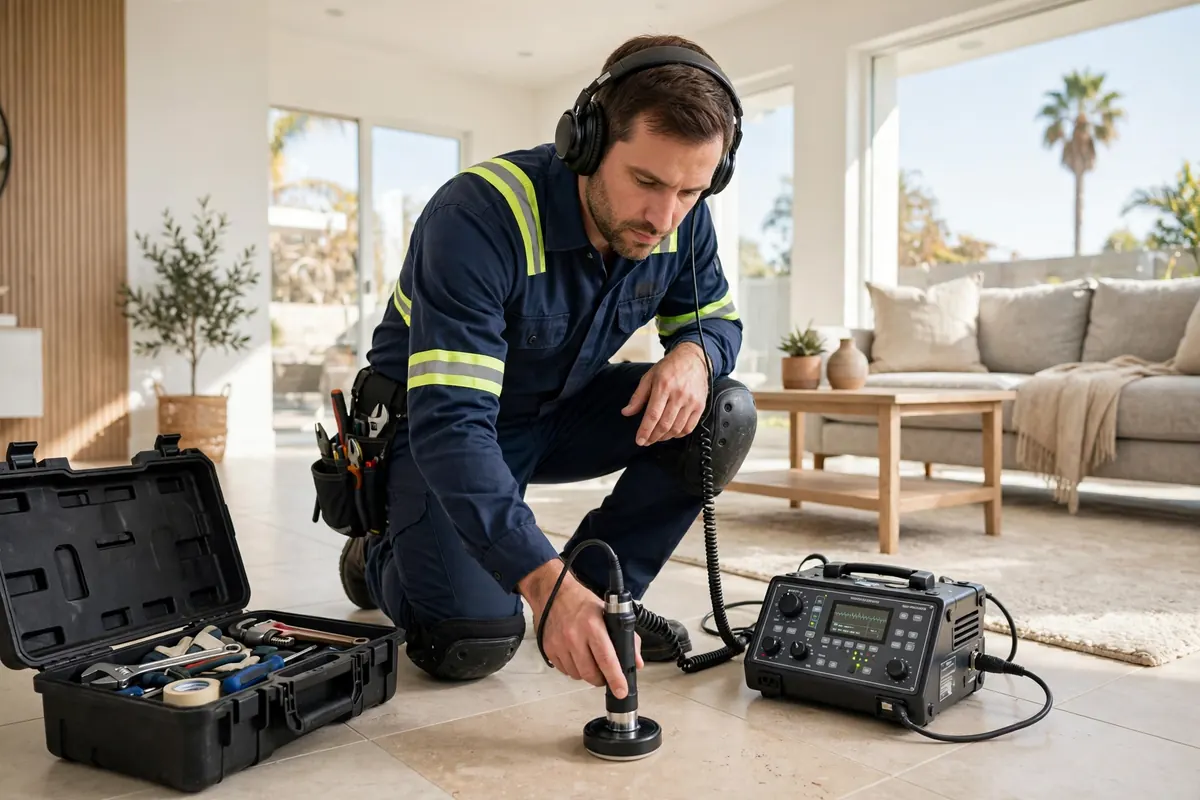
The process starts at accessible listening points — hose bibs, valves, meters, and cleanouts. A contact sensor pressed against the pipe picks up the leak's vibration and the technician compares readings across multiple points to determine which pipe section is involved. Then a ground microphone sweeps the surface above the line: the signal grows steadily louder as the sensor approaches the leak and fades past it, narrowing the location to a small area.
For long or noisy runs, a correlator can be used: two sensors placed at either end of a pipe section measure the tiny time difference in the leak sound arriving at each, calculating the distance to the leak mathematically. The key requirement is pressure — the pipe must be charged for there to be anything to hear, which is why a brief pressure check often comes first.
Acoustic methods are at their best on pressurized supply lines: copper and galvanized water lines under slabs, underground service lines between the meter and the house, and hot-water recirculation loops. Sound travels exceptionally well through concrete, which makes acoustic listening one of the most effective approaches for slab leaks in Alhambra's many post-war ranch homes.
It also works through soil, asphalt, and pavers, so an underground main-line leak can be traced across a yard or driveway without exploratory digging. When background noise is high or the pipe is plastic (which muffles sound), we pair acoustic results with a second method such as tracer gas or thermal imaging rather than guessing.
No single method finds every leak, and acoustic listening is no exception. It is less effective on gravity drains and sewer lines, where water is not under pressure and makes little noise. Very small pinhole leaks with low system pressure can also be faint, and noisy environments — traffic, pumps, appliances — can mask the signal.
That is why a professional survey never relies on one tool alone. When acoustic results are inconclusive, the next step is typically a pressure-isolation test to confirm which line is losing water, followed by tracer gas or thermal imaging to finish the pinpoint. You get a marked location, not a vague area.
Alhambra's housing stock tells the story: homes built from the 1930s through the 1970s are now running on pipe materials at or past their typical service life. Galvanized steel corrodes from the inside, cast iron joints separate, and copper develops pinhole leaks — all of which start as hidden, pressurized leaks that acoustic equipment is designed to hear.
Catching these early matters. A pinhole leak under a slab can run for months, undermining soil, feeding mold, and adding hundreds to water bills before it ever shows itself. A one-visit acoustic survey that marks the leak's position turns a potential jackhammer-the-whole-floor job into a single targeted opening.
We start with a no-use meter test to confirm water is actually escaping the system before any equipment comes out.
Valves and fixtures are used to narrow the loss to a section of pipe — hot vs. cold, interior vs. service line.
Electronic sensors on fittings and valves compare leak noise across points to identify the involved run.
A ground microphone sweeps the surface above the line, following the signal to its peak — the leak's position.
The location is marked on the surface and documented so any repair opens one precise spot, not a trench.
Find the leak under your concrete foundation — and open one precise spot instead of the whole floor.
Learn more →Infrared cameras that reveal the heat signature of hidden water — without a single hole in your walls.
Learn more →A safe hydrogen tracer gas that escapes through the tiniest cracks — and leads our sensors straight to the leak.
Learn more →Your water line runs from the meter to your house underground. When it leaks there, we find it — without excavating the yard.
Learn more →Every day a hidden leak runs, the water bill climbs and the damage spreads. Call now — we answer 24 hours a day.
+1 626-898-6221 ☎ Call Now Request Leak Detection Service