Losing water faster than evaporation can explain? We find the leak — shell, plumbing, or equipment.
Every pool loses some water to evaporation — in Southern California, that is a fact of life. But when you are adding inches every week, running the fill valve constantly, or watching the water bill climb with the pool, you are past evaporation and into leak territory. The question is where: the shell, the skimmer, the underground plumbing, or the equipment pad.
Pool and spa leak detection answers that systematically: first ruling out evaporation with a simple bucket test, then pressure-testing each plumbing line independently, then using dye testing and electro-acoustic listening to pinpoint the breach. No draining the pool on a hunch, no digging up decking to look around.
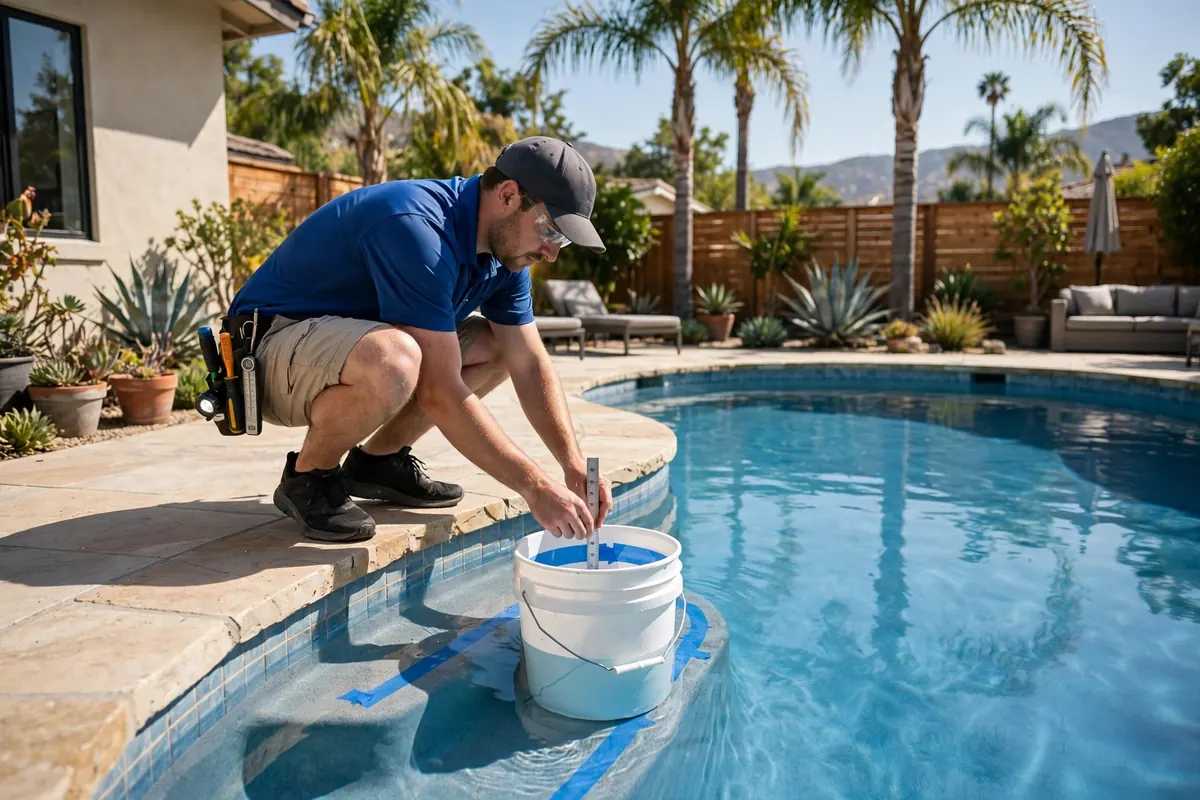
Before any equipment comes out, the honest first step is the bucket test: fill a bucket with pool water, set it on a pool step so the water levels inside and outside match, and mark both. After 24 hours with the pump off, compare. If the pool dropped more than the bucket, the difference is a leak, not evaporation.
This simple test prevents the most common pool-owner mistake — paying for leak detection on a pool that is simply evaporating in Santa Ana winds. If the bucket test says leak, the investigation proceeds with confidence. If it says evaporation, you have saved yourself the call-out.
Pool leaks fall into three zones. Structural: cracks in the plaster, gunite, or tile grout; failed seals around skimmers, returns, lights, and main drains; coping separation. Plumbing: the underground suction and return lines — skimmer lines, main drain lines, cleaner lines — which can crack from ground movement, root pressure, or age. Equipment: the filter, pump seals, heater, valves, and above-ground plumbing on the equipment pad, which are the easiest to check and often the culprit.
Each zone gets a different test, which is why a methodical sequence matters more than any single gadget. Jumping straight to excavation without isolating the zone is how pool decks get destroyed unnecessarily.
The core diagnostic is line-by-line pressure testing. Each plumbing run — skimmer, main drain, each return, the cleaner line — is plugged at both ends and pressurized independently. A line that holds pressure is eliminated; a line that drops is the leaker. This single procedure narrows the search from 'somewhere in the pool system' to one specific pipe.
Once the leaking line is identified, electro-acoustic listening traces it underground — the same principle used for buried water mains, adapted for pool plumbing — to mark where along that run the breach sits. For structural suspects, a dye test with the pump off shows dye being drawn into cracks or failed seals, visible to the trained eye.
Spas leak by the same mechanisms — shell fittings, jets, plumbing, and equipment — concentrated into a smaller, more complex footprint. A spa that needs frequent refilling, shows wetness around its base, or trips its heater from low water deserves the same systematic approach: evaporation check, equipment inspection, then line isolation.
Because spa plumbing is dense and often foam-insulated, detection here leans heavily on pressure testing individual runs and careful equipment-pad diagnosis before any surface is opened.
We start with evaporation ruled out — via your bucket test results or a fresh one — so the investigation targets a real leak.
Pump, filter, heater, valves, and above-ground plumbing are checked first; the simplest causes are eliminated early.
Each underground line is plugged and pressurized independently to identify exactly which run is losing water.
Electro-acoustic listening traces the leaking line underground; dye testing checks structural suspects like skimmers and fittings.
The leak's location — shell, line, or equipment — is documented so repair addresses the actual breach, nothing else.
Electronic listening that pinpoints hidden leaks — without tearing open walls or digging up floors.
Learn more →Finding the leak is step one. Mapping exactly how far the water traveled is step two.
Learn more →Your water line runs from the meter to your house underground. When it leaks there, we find it — without excavating the yard.
Learn more →Find the leak under your concrete foundation — and open one precise spot instead of the whole floor.
Learn more →Every day a hidden leak runs, the water bill climbs and the damage spreads. Call now — we answer 24 hours a day.
+1 626-898-6221 ☎ Call Now Request Leak Detection Service