Infrared cameras that reveal the heat signature of hidden water — without a single hole in your walls.
Water changes the temperature of the materials it touches. A hot-water line leak leaves a warm trail across a floor; a cold-water leak or established patch of damp shows up as a cooler area where evaporation is happening. Thermal imaging leak detection uses an infrared camera to read those surface-temperature differences — some as small as a fraction of a degree — and display them as a color-mapped image of exactly where moisture is hiding.
For Alhambra homeowners, the appeal is simple: answers without destruction. Instead of cutting exploratory holes in drywall or pulling up flooring on a guess, an infrared scan surveys whole rooms in minutes and points the investigation at the right spot. It is entirely non-contact — the camera never touches your walls, floors, or ceilings.
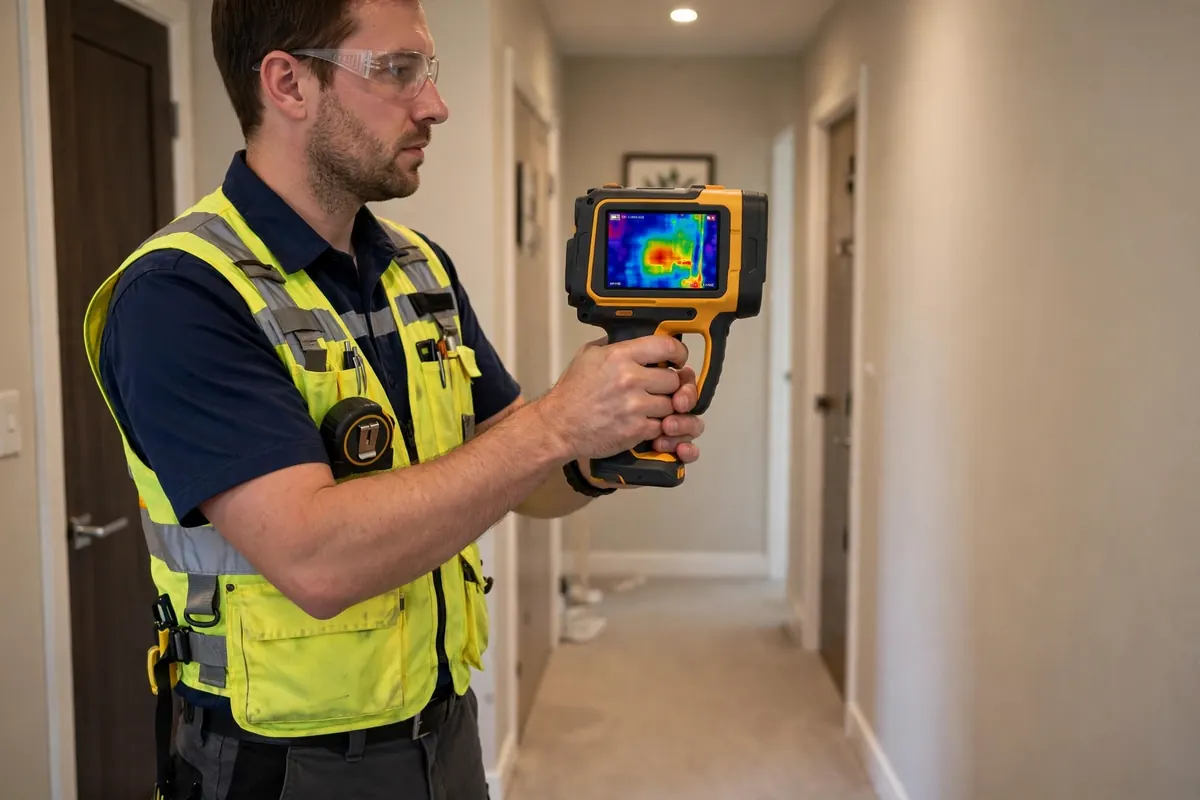
The technician walks the suspect area slowly with the infrared camera, watching the live thermogram for anomalies. A leaking hot-water pipe paints a warm plume along its route; a cold supply leak or a patch of trapped dampness appears cooler than the surrounding dry material because evaporating water draws heat away. Water also migrates — it tracks along pipes, joists, and the back of drywall before surfacing somewhere else — so the camera often reveals the leak's path, not just a single point.
Because the scan covers large areas quickly, it is excellent for triage: one pass over a bathroom, laundry room, or slab floor shows which zones deserve closer investigation and which can be ruled out. That alone can save hours of exploratory work.
An honest note first: a thermal camera does not see through walls, and it does not see water itself. It reads surface temperature, and a trained eye interprets the patterns. Thick insulation, direct sunlight on a wall, or a recently run heating system can all create temperature patterns that look interesting but mean nothing — which is why the scan is done under controlled conditions and every finding is verified.
Verification is non-negotiable. A thermal anomaly is confirmed with a pin or pinless moisture meter pressed to the surface, and often with a second method such as acoustic listening, before anyone marks a spot for opening. Thermal imaging tells you where to look; the moisture meter tells you the water is really there.
Thermal imaging shines on hot-water and hydronic lines, where the temperature contrast is strongest — a leaking hot supply line under a slab or behind a shower wall practically announces itself. It is also the fastest way to survey large or finished areas: ceilings below upstairs bathrooms, walls behind kitchens, and floors over radiant or recirculation loops.
For deep underground mains or plastic pipework, acoustic listening or tracer gas usually takes the lead, with thermal playing a supporting role at the surface. The methods complement each other, and a good survey uses whichever combination the situation calls for rather than forcing one tool to do everything.
More than 80% of Alhambra's homes are over 30 years old, and many still carry their original plumbing: galvanized steel from the 1930s–60s that corrodes from the inside, cast iron from the 1940s–70s whose joints separate, and copper from the 1960s onward that is prone to pinhole leaks. These failures rarely announce themselves — they seep behind plaster and under tile for months.
In finished homes where every wall opening means patching, texture-matching, and repainting, a non-invasive first look is worth a great deal. A thermal survey maps the moisture before any repair decision is made, so the fix — whatever it turns out to be — starts from evidence instead of guesswork.
We review the symptoms and prepare the area — minimizing heat sources and airflow that could skew the readings.
The camera surveys walls, ceilings, and floors, and we note every temperature anomaly with its location and pattern.
Each anomaly is checked with pin or pinless moisture meters to confirm real moisture versus a thermal false positive.
Confirmed moisture is traced back along its path — to a pipe route, fixture, or entry point — using acoustic or pressure checks if needed.
You receive a clear report of what was found, where, and what the recommended next step is — no vague hand-waving.
Electronic listening that pinpoints hidden leaks — without tearing open walls or digging up floors.
Learn more →That stain isn't always where the leak is. We trace it to its true source — before you fix the wrong thing.
Learn more →Find the leak under your concrete foundation — and open one precise spot instead of the whole floor.
Learn more →Finding the leak is step one. Mapping exactly how far the water traveled is step two.
Learn more →Every day a hidden leak runs, the water bill climbs and the damage spreads. Call now — we answer 24 hours a day.
+1 626-898-6221 ☎ Call Now Request Leak Detection Service