Your water line runs from the meter to your house underground. When it leaks there, we find it — without excavating the yard.
The water service line — the buried pipe carrying water from the meter to your house — is one of the longest pipes you own and the one you never see. When it leaks underground, the symptoms are indirect: a climbing water bill, a soggy patch in the yard, a strip of suspiciously lush grass, or the faint sound of running water with everything turned off.
Underground main line leak detection confirms the leak with your water meter, then traces the buried line with acoustic listening, pressure testing, and tracer gas to mark the breach's position on the surface. No exploratory trenches across the lawn, driveway, or walkway — one marked spot, ready for a targeted repair.
Before calling anyone, you can confirm an underground leak in about an hour. Turn off every fixture and appliance that uses water — or, more simply, close your main shutoff valve. Then look at the water meter: most have a small leak indicator — a triangle or star-shaped dial — that spins with even tiny flows. If it moves with everything off, water is escaping somewhere between the meter and your fixtures.
For a stronger test, record the meter reading, avoid all water use for one to two hours, and read it again. Any movement is proof of a leak. Also rule out the usual suspects first: a running toilet (food coloring in the tank will show it) and irrigation schedules. What remains is very often the buried service line.
An underground leak leaves a signature on the surface if you know what to look for. A lush green strip following the pipe's route from meter to house is the classic sign — the leak is fertilizing one line of turf. Spongy or sunken soil, pooling water, or a depression forming in the yard means soil is eroding around the breach. In dry weather these signs stand out clearly against the surrounding ground.
Inside the house, the clues are a pressure drop across all fixtures and that faint hissing at the main shutoff — the sound of pressurized water escaping underground, transmitted up the pipe. Any one symptom is worth checking; two together make the diagnosis likely before we even arrive.
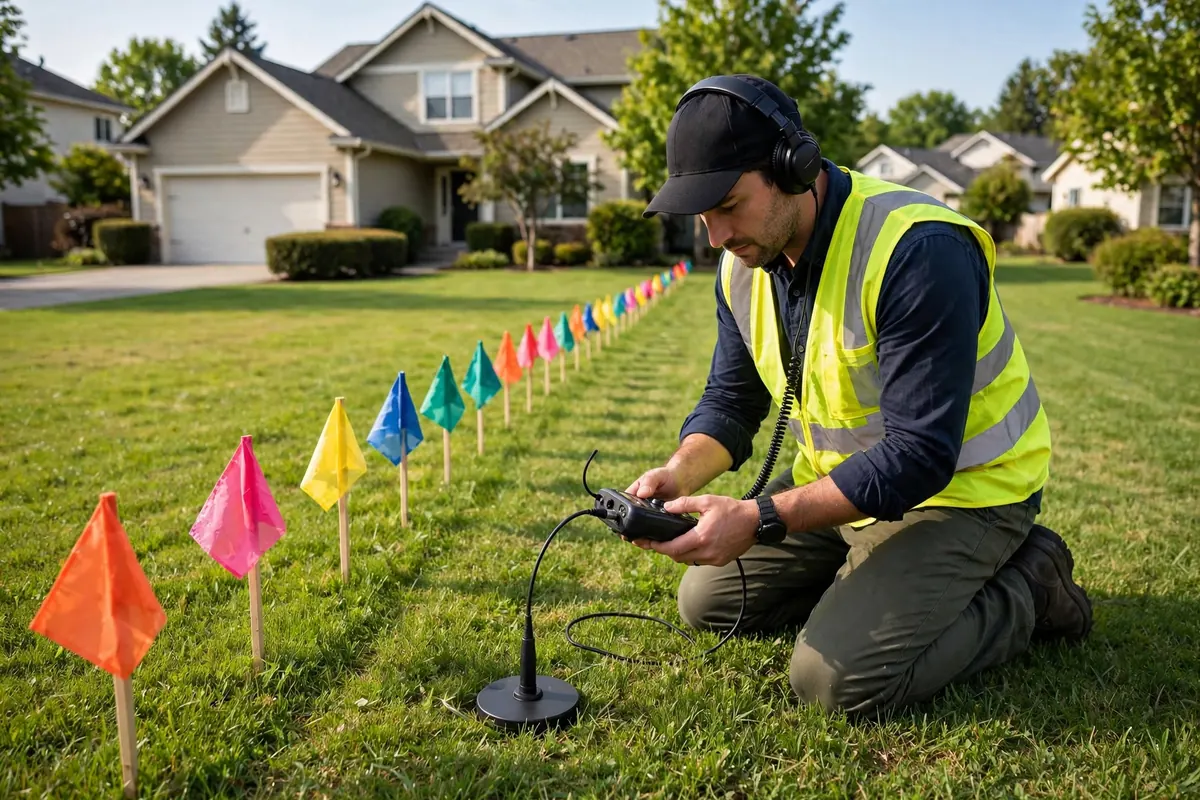
Pinpointing starts with pressure testing to confirm the service line — rather than interior plumbing — is the culprit. Then acoustic listening takes the lead: a ground microphone sweeps the surface along the line's route, following the leak's sound to its loudest point. For deep lines, plastic pipe, or noisy locations, tracer gas provides the answer acoustics cannot.
The line's route itself is established first — from the meter box toward the house entry — so the search follows the pipe rather than wandering the yard. The outcome is a marked position on the surface, typically within a small area, with the depth estimated so any repair digs exactly where it should.
A frequent question with a consistent answer: the homeowner is generally responsible for the service line from the water meter to the house, while the utility owns everything up to and including the meter. The meter box and curb stop are the utility's; the buried line on your side of the meter is yours to maintain.
This matters because it determines who pays for the repair — which is all the more reason to get the leak located precisely before any work begins. A marked, documented leak position also helps if you need to discuss the situation with your water provider or file an insurance claim.
We run a controlled no-use meter test to confirm water is escaping and estimate the loss rate.
The service line's path from meter to house entry is traced so the search follows the pipe.
Pressure testing isolates the service line from interior plumbing to confirm it is the leaking section.
Ground microphones — or tracer gas for deep, plastic, or noisy lines — narrow the breach to a marked surface position.
The location and estimated depth are marked and documented for a targeted, minimal repair excavation.
Electronic listening that pinpoints hidden leaks — without tearing open walls or digging up floors.
Learn more →A safe hydrogen tracer gas that escapes through the tiniest cracks — and leads our sensors straight to the leak.
Learn more →Prove the leak exists — and isolate exactly which line it is on — before any pinpointing begins.
Learn more →Find the leak under your concrete foundation — and open one precise spot instead of the whole floor.
Learn more →Every day a hidden leak runs, the water bill climbs and the damage spreads. Call now — we answer 24 hours a day.
+1 626-898-6221 ☎ Call Now Request Leak Detection Service